




Chaque année, le Baromètre de la performance énergétique et environnementale de l'OID dresse un état des lieux précieux de la maturité ESG du secteur immobilier. Cet article se concentre sur les enseignements clés relatifs à la performance énergétique et environnementale, avec un focus sur les actifs tertiaires, au cœur des obligations du Décret Tertiaire et des enjeux de trajectoire carbone.
While the barometer addresses other dimensions such as ESG governance, climate adaptation, and biodiversity, here we analyze the section directly related to consumption, emissions, and operational dynamics in the service sector. For a comprehensive overview, the full study is available on the OID website.
A real estate sector structured around energy and carbon
La majorité des acteurs immobiliers ont désormais intégré les fondamentaux énergétiques et carbone dans leur stratégie. On observe une stabilisation des indicateurs de performance (kWh/m²/an, kgCO₂/m²/an), des objectifs alignés sur l'Accord de Paris et les trajectoires CRREM, ainsi qu'une gouvernance ESG mieux outillée.
L'OID note une homogénéisation bienvenue des pratiques, permettant au secteur d'avancer collectivement. L'énergie devient le premier enjeu priorisé, juste devant le carbone, confirmant cette concentration des efforts sur l'atténuation. Cependant, cette structuration stratégique ne garantit pas encore une performance opérationnelle suffisante.
A transition in pause mode: consumption stagnates in 2024
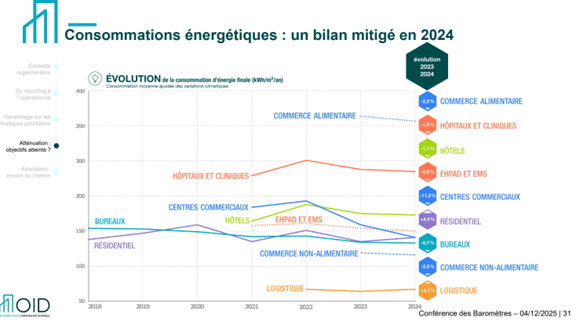
Les données 2024 révèlent un constat sans détour : la baisse des consommations énergétiques marque le pas. La plupart des typologies de bâtiments affichent des évolutions modestes (–1 % à –2 %), insuffisantes pour atteindre les objectifs nationaux.
Sector-by-sector overview
- Secteurs énergivores (hôpitaux, hôtels, EHPAD) : quasi-stagnation.
- Bureaux : très légère baisse (–0,7 %), signe d'un palier technique.
- Résidentiel et logistique : repartent à la hausse (+4,4 % et +4,1 %).
- Centres commerciaux : une exception notable avec une réduction de –11,3 %, qui ne compense pas la tendance générale.
Ce paysage montre que la transition énergétique ralentit, alors que les exigences réglementaires, notamment celles du Décret Tertiaire, nécessitent une accélération. L'ambition stratégique est là, mais le passage à l'action opérationnelle devient le véritable défi.
Businesses: visible but uneven efforts
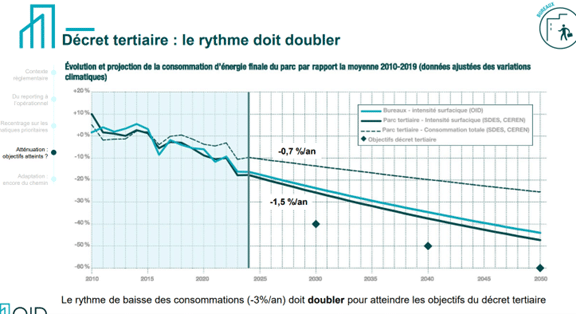
Food (-2.9%) and non-food (-3.5%) retailers are reducing their energy consumption, and their greenhouse gas emissions are following a similar trajectory. However, this progress remains modest and highly variable across different locations. This sector has significant potential for optimization, particularly through better management of energy use (lighting, refrigeration, ventilation) and increased automation.
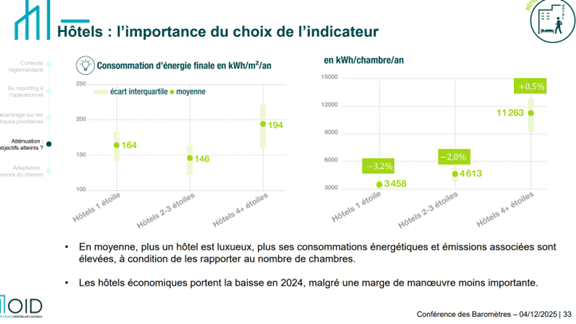
Hospitality: the importance of the right indicator
The hotel sector perfectly illustrates the importance of choosing the right indicator. When measured per square meter, high-end hotels have the highest energy consumption. However, when measured per room, budget hotels become the most efficient.
An indicator is only valuable if it accurately reflects the actual use of the building.
In the hotel industry, the room is the relevant functional unit. A poor indicator can lead to flawed investment decisions.
Data quality: the Achilles' heel of performance
Only 53% of the energy data collected is usable after quality control. This structural deficiency limits the ability to effectively manage performance. Without robust data, there can be no reliable management, and therefore no credible energy trajectory.
Energy Management: The Key to Taking Action
Energy management is becoming the key to transforming intention into results. It allows us to:
- Identify the real potential for savings.
- Prioritize tasks based on their impact and ROI.
- Aligning teams around common goals.
- Securing performance over the long term.
It forms the backbone for translating climate ambitions into measurable and profitable results.
Act, Measure, Prove to meet objectives and achieve results
The OID 2025 Barometer sends a clear signal: the real estate sector is structured and committed, but it now needs to accelerate. The refocusing on energy and carbon provides the strategic foundation. Ensuring reliable data and deploying operational Energy Management will enable the achievement of real performance. In a market where a building's value increasingly depends on its energy performance, controlling energy means controlling one's future.