





Each year, the OID's Energy and Environmental Performance Barometer provides a valuable overview of the ESG maturity of the real estate sector. This article focuses on key findings related to energy and environmental performance, with a particular emphasis on commercial real estate assets, which are central to the requirements of the French Tertiary Sector Decree and the challenges of achieving carbon emissions.
While the barometer addresses other dimensions such as ESG governance, climate adaptation, and biodiversity, here we analyze the section directly related to consumption, emissions, and operational dynamics in the service sector. For a comprehensive overview, the full study is available on the OID website.
A real estate sector structured around energy and carbon
The majority of real estate players have now integrated energy and carbon fundamentals into their strategy. We are seeing a stabilization of performance indicators (kWh/m²/year, kgCO₂/m²/year), targets aligned with the Paris Agreement and CRREM trajectories, as well as better-equipped ESG governance.
The OID notes a welcome harmonization of practices, allowing the sector to move forward collectively. Energy has become the top priority , just ahead of carbon, confirming this focus on mitigation efforts. However, this strategic structuring does not yet guarantee sufficient operational performance.
A transition in pause mode: consumption stagnates in 2024
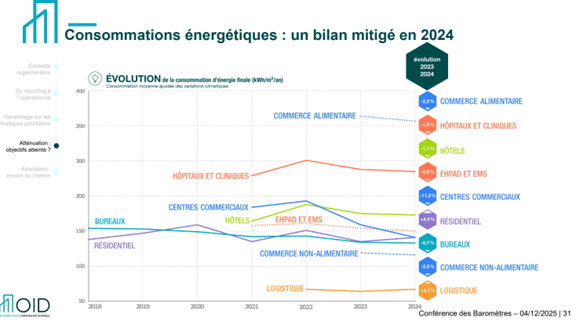
The 2024 data reveals a clear conclusion: the reduction in energy consumption has stalled. Most building types show modest changes (-1% to -2%), insufficient to meet national targets.
Sector-by-sector overview
- Energy-intensive sectors (hospitals, hotels, nursing homes): near stagnation.
- Offices: very slight decline (-0.7%), a sign of a technical plateau.
- Residential and logistics: are rising again (+4.4% and +4.1%).
- Shopping centres: a notable exception with a reduction of -11.3%, which does not offset the general trend.
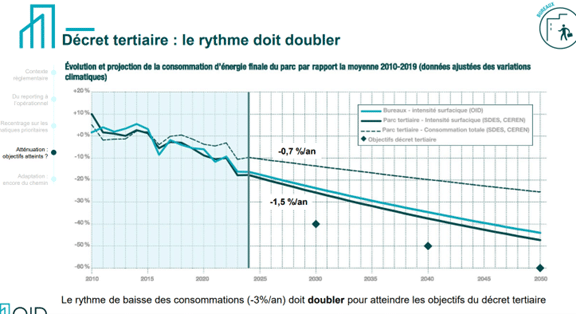
This landscape shows that the energy transition is slowing down, while regulatory requirements, particularly those of the Tertiary Decree, demand acceleration. The strategic ambition is there, but the real challenge lies in translating it into operational action.
Businesses: visible but uneven efforts
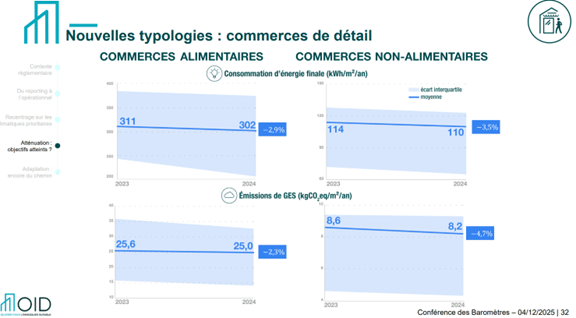
Food (-2.9%) and non-food (-3.5%) retailers are reducing their energy consumption, and their greenhouse gas emissions are following a similar trajectory. However, this progress remains modest and highly variable across different locations. This sector has significant potential for optimization, particularly through better management of energy use (lighting, refrigeration, ventilation) and increased automation.
Hospitality: the importance of the right indicator
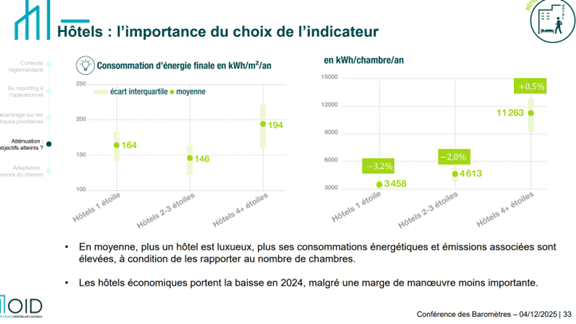
The hotel sector perfectly illustrates the importance of choosing the right indicator. When measured per square meter, high-end hotels have the highest energy consumption. However, when measured per room, budget hotels become the most efficient.
An indicator is only valuable if it accurately reflects the actual use of the building.
In the hotel industry, the room is the relevant functional unit. A poor indicator can lead to flawed investment decisions.
Data quality: the Achilles' heel of performance
Only 53% of the energy data collected is usable after quality control. This structural deficiency limits the ability to effectively manage performance. Without robust data, there can be no reliable management, and therefore no credible energy trajectory.
Energy Management: The Key to Taking Action
Energy management is becoming the key to transforming intention into results. It allows us to:
- Identify the real potential for savings.
- Prioritize tasks based on their impact and ROI.
- Aligning teams around common goals.
- Securing performance over the long term.
It forms the backbone for translating climate ambitions into measurable and profitable results.
Act, Measure, Prove to meet objectives and achieve results
The OID 2025 Barometer sends a clear signal: the real estate sector is structured and committed, but it now needs to accelerate. The refocusing on energy and carbon provides the strategic foundation. Ensuring reliable data and deploying operational Energy Management will enable the achievement of real performance. In a market where a building's value increasingly depends on its energy performance, controlling energy means controlling one's future.